Home › Running & training
Hydration for running and training
Sweat rate varies from roughly 0.5 to over 2 litres an hour between athletes and conditions. A single hourly number cannot cover that range — your heart rate and the weather can narrow it.
Why a fixed hourly amount fails athletes
Two runners doing the same 10 km can lose amounts of fluid that differ by a factor of three, depending on body mass, fitness, acclimatisation and the day's heat. Generic advice has to pick a middle number, which under-serves heavy sweaters and overdoes it for everyone else.
Effort is the piece a step counter misses entirely. Heart-rate reserve — where your current heart rate sits between your resting and maximum — tracks metabolic load far better than pace or cadence, and metabolic load is what drives sweat.
Recovery matters as much as the session. Deficit accumulated during a hard hour does not disappear at the finish line; HydroPulse keeps the ledger negative afterwards and keeps asking until it is repaid.
What HydroPulse does here
- An exertion component driven by heart-rate reserve, so an easy jog and a threshold effort are not treated alike.
- A sweat profile setting (light, average, heavy) for personal calibration.
- Heat-index scaling, so the same session in July asks for more than in November.
- Post-session deficit that carries forward instead of resetting.
- Urgency levels, so a mild nudge mid-warm-up does not look like an urgent one at kilometre 15.
How HydroPulse decides
- You enter your weight, age and sweat profile once. That sets your personal baseline loss — the water you lose just by being alive and breathing.
- The watch reads your heart rate continuously and converts it into a heart-rate-reserve fraction: how hard you are working relative to your own resting and maximum heart rate, not to an average person's.
- Local temperature and humidity are fetched anonymously and turned into a heat-index multiplier, because the same effort costs far more fluid at 33 °C and 70 % humidity than at 18 °C.
- Every drink you log is credited back to the ledger. When the running balance crosses your threshold, HydroPulse tells you — with a specific millilitre amount and the reason behind it.
What to expect
For best results set your resting and maximum heart rate rather than leaving the age-based estimate, and pick the sweat profile that matches your experience of yourself. If you have ever weighed yourself before and after a long session, the difference in kilograms is roughly your fluid loss in litres — that is the single most useful calibration input you can bring.
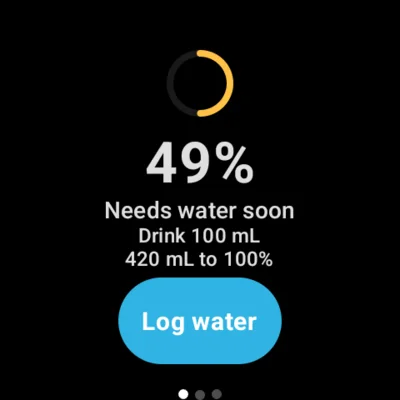
Your balance as a dial, with the amount to drink now. 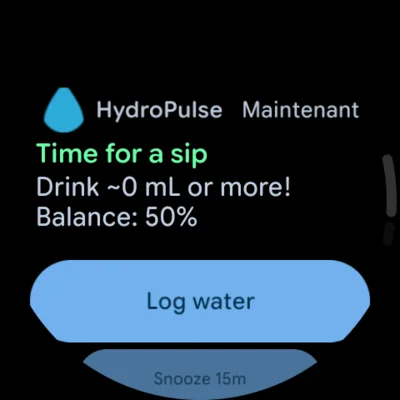
One tap to log, one to snooze — the phone stays in your pocket.

Wear OS 3.0+. One-time purchase — no subscription, no ads, no account. The app interface is in English.
Common questions
Can it replace a proper sweat-rate test?
No. Weighing yourself before and after a session under known conditions remains the gold standard. HydroPulse estimates continuously from sensors, which is far more practical day to day but less precise than a controlled test.
Does it handle drinking during a race?
It will keep estimating and keep crediting logged intake, and the notification action makes logging fast. Many athletes also snooze it through a race and use the history afterwards to see what the deficit looked like.
What about electrolytes?
HydroPulse tracks fluid volume, not sodium. For long or very hot sessions, electrolyte replacement is a separate question and worth reading up on — drinking large volumes of plain water over many hours is not risk-free.
Does it count coffee and tea?
You can log any drink. Moderate caffeinated drinks do contribute to daily fluid intake for habitual consumers; alcohol is the one that works against you.
Where the model comes from
The baseline draws on IOM and EFSA adequate-intake figures, the sweat-rate component on ACSM exercise-hydration guidance, and the environmental multiplier on the US National Weather Service heat-index formula. These are population references adapted to what a watch can actually sense — a well-founded estimate, not a laboratory measurement.
Not a medical device
HydroPulse produces an estimate, not a measurement. It is a wellness tool, not a medical device, and it does not diagnose, treat or monitor dehydration or any other condition. If you take diuretics, restrict fluid on medical advice, or have a kidney, heart or endocrine condition, follow your clinician's intake guidance rather than this app's. Seek urgent care for confusion, fainting, or heat illness.
Private by design
Your heart rate, activity and drink log never leave the watch. There is no account, no advertising SDK and no product analytics — nothing tracks what you do in the app. Two things do leave the device: a pair of coordinates to a public weather service, with no identifier attached, and a crash report if the app fails. Neither carries your health data.
More on hydration
- On Wear OSA water reminder built for the watch, not a phone app with a complication.
- Hot weatherWhen heat and humidity raise your needs, the reminders move first.
- At workFor desk days where six hours vanish between two glasses.
- How much per dayWhere the 2-litre rule comes from, and why your number is not that.
- Signs of dehydrationWhat mild dehydration actually feels like — and when it stops being mild.
- Heart rate & hydrationThe link between cardiac drift, effort and fluid loss.